

School Uniform Bank - Back to School & Nursery (South Crieff)
2025-02-07 • No comments • • South Crieff
2025 will be our fourth year running our Back to School Pack. In 2021 we provided 152 packs, in 2022 - 340, in 2023 - 400, and in 2024 we provided 512 Back to School Packs and 91 Back to Nursery Packs (our first year running this service). Our Packs are available to anyone who lives in these wards.
What is in a Back to School Pack?
Our packs include 3 shirts, 2 bottoms, 2 jumpers/cardis, 2 PE t shirts, 2 PE bottoms, a PE jumper and a school bag. We also aim to include school shoes and/or trainers plus stationary and other back to school essentials like pack lunch boxes or pencil cases. Everything a child needs for taking part in their school journey.
What is in a Back to Nursery Pack?
Our Back to Nursery packs include 5 days of mix and match outfits; 5 jumpers, 5 t-shirts, 5 bottoms, messy play clothing, a seasonal jacket and footwear. We also add in extras such as sun hats, vests and socks as we know children need these items to fully participate in their learning and no one comes home clean after one day in nursery!
Packs are personalised to each schools colours and the child’s style preferences (so you can tell us if they won’t wear shorts, or will only wear cardigans!) and their sensory needs to make sure the packs are made to suit the individual. We also ask for bag colours and characters and try our hardest to match up to their personal style. We believe our service should make the child feel confident and comfortable that they match their peers.
SO IF YOU THINK THAT...
- All children should have access to high quality school uniform?
- We should protect our environment and make positive pre-loved clothing choices?
- By making little changes to our own lifestyle to support others we can make big changes for the future of our children?
Then please support us by voting for our Back to School & Nursery Pack project. Thank you.
Team Social Flock
.png)
Care Van, Perth
2025-02-06 • 2 comments • • Central and North Perth
The Care Van operates with the support of local churches in Perth, Holy Trinity, St John’s Episcopal Church and St Marks, Letham. The outreach model reduces barriers to accessing support whenever possible and is available to all. The Care Van brings community and support to those in Perth who need it. Every Wednesday the Care Van is located at St Catherines Square and St John’s Episcopal Church, strategically located near multiple temporary accommodation hostels. During the winter months, this stop with St John’s operates as a warm space. In July 2024 the service expanded to the Letham area, as it was identified as an area where one-to-one support often took place. This stop has been in demand from the outset, with 415 access to support since launching.
Swarthick, our Pioneer Coordinator who runs the Care Van, has worked with people experiencing homelessness in Perth for over a decade, and he was highly involved in shaping the service of the Care Van to ensure it was addressing local needs. There are several well-established organisations in Perth who provide a meal for those who need it, but we identified a serious lack of outreach and support for transient individuals struggling with homelessness and other complex needs. Our Care Van is helping to fill this gap. The demand for Swarthick's time and assistance since he initiated the Care Van in 2021 is further evidence of the need. He supports over 1,500 presentations each year through the van and through those connections, he assists around 60 people with more targeted, one-to-one support. And last year, the demand for one-to-one support was much greater, in large part due to the Cost-of-Living Crisis. A local resident himself, Swarthick has become well-known in the community, and he is often stopped by service users wanting support on visits to the supermarket or walks along the high street in his free time.
Two examples of the collaborative work done by our Pioneer Coordinator and volunteers:
During our regular care van stops, we met Cindy. She was quite shy and hesitant to approach the van at first, but after a lot of reassurance, she found the confidence to approach the van and accept some support. She was suffering from the consequences of a traumatic and abusive marriage breakdown, and she didn't know where to go for help. Over a few weeks, we were able to signpost her to various organisations, and we offered one-to-one support whenever she needed. Remarkably over a period of 8 months, Cindy built her confidence enough to find work. She also moved out of social housing into a private let and has held a job ever since. We're still in touch with Cindy and every now and then still receive a message from her stating how grateful she is for the support we gave her.
John was already receiving some one-to-one support when he received a letter from the DWP that he didn't understand. On reading the letter, Swarthick thought it was strangely worded, and the letter asked for proof of ID. Swarthick phoned the helpline for John, and it was suggested that the letter must be sent in error because they don't need evidence for clients who have been in receipt of benefits for several years, as John had. They said nothing further needed to be done; however, three months later another letter appeared asking the same questions and threatening detrimental consequences if there was no response. This made John panic, and his anxiety peaked. John has limited literacy and is unable to use a computer, which made handling the situation even harder for him. Swarthick called the helpline again and was put through to the department that investigates fraud. They said that a form of sophisticated fraud was committed using John's details and that is why photographic evidence was needed to confirm his identification. John only had a bus pass as a form a photo ID, and Swarthick suggested that a copy of the bus pass could be posted. Swarthick also informed them about John's literacy, and based on this information, they said that an official would contact Swarthick if they required to get in touch with the service user. A few weeks later, the entire case was dropped due to the rightful intervention. John was delighted with the outcome, and his anxiety dramatically reduced once the situation was resolved.
Royal Voluntary Service - Mini Bus support scheme
2025-01-23 • No comments • • Central and North Perth
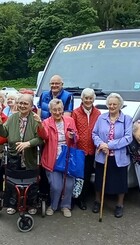
The Royal Voluntary Service manage approx 150 volunteers in the Perth & Kinross region and we have a need for transport to support the elderly & vulnerable in the community.We are applying for a mini bus and need to upskill the volunteers for the coming years. We would like to train 10 drivers on the MIDAS mini bus course and also 15 first aiders. Currently we run Perth lunch club,Perth social club,Crieff lunch club,Bridge of Earn lunch club and are looking at a new lunch club in North Muirton. The elderly clients need transport to get them to the clubs which will greatly help with nutrition ,mental and physical well being. We are being tasked with growing the numbers at each of the clubs and opening new venues thus requiring a transport solution.
This vital training will allow us to run this service.